Slump Test for Concrete
The slump test is used at construction sites to measure the workability of fresh concrete. It can help determine whether the concrete has the proper water–cement ratio for easy mixing, transporting, and placing in the casting place. A proper slump ensures that the concrete can be compacted properly without segregation or bleeding. Therefore, the slump test is directly connected with quality control in construction, helping ensure the strength and durability of concrete structures.
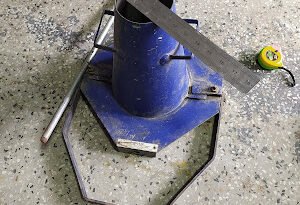
Apparatus:
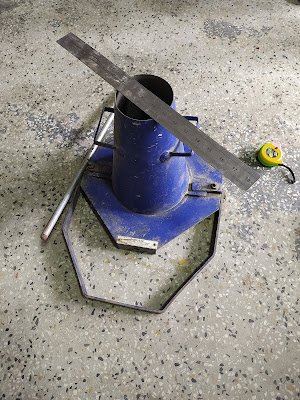
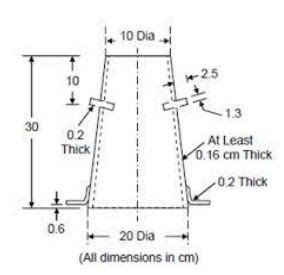
1) Slump Cone ( having diameter of 4″ or 10 cm. and 8″ or 20 cm. also have a height of 12″ or 30 cm.
2) Measuring Scale
3) Temping Rod 16 mm diameter
Procedure:
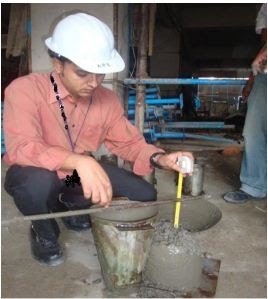
1) The base should placed on a smooth surface and the cone will filled in three (03) layer with concrete.
2) Each layer have to temped 25 times with temping rod.
3) After filling the mould, excess concrete should be removed and the surface should be leveled. When the mould will filled fresh concrete, the base of the mould will held firmly by handles.
4)Then the mould will lifted gently in the vertical direction and then unsupported concrete will slump. The decrease in height at the center point is measured to nearest 5 mm or 0.25 inch and it is known as “slump”.
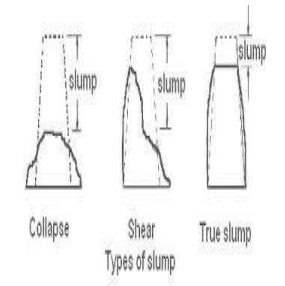
Types of Concrete Slump:
1) True Slump.
2) Collapse slump
3) Shear Slump
Results Can be Classified With slump Values are as follows:
| Degree of Workability | Slump | Suitable to Use |
| Very Low | 0-25 | Used in Road work |
| Low | 25-50 | Used in Foundation with light reinforcement road vibrate by hand operated machine |
| Medium | 50-100 | Used in normal reinforced concrete manually compacted and heavily reinforced section with vibrations. |
| High | 100-175 | Used in section with congested reinforcement. Not normally suitable for compaction. |
Advantages of Concrete Slump Test:
1.Slump test is very easy and simple. Even non-technical person can perform it in construction site without any problem.
2.This test does not require any special or costly equipment and not to send the sample at laboratory. It can be done in the construction area.
3.It is very essential to check batch to batch or hour to hour variation in the materials which will be fed into the mixer. Too high or too low slump is an indicator of unwanted workability of concrete and mixer operator gets an alarm to find a solution to remedy the problem.
4.Slump test does not demand a long-time period to get the result. We can obtain slump value within some minutes.
Limitations or Disadvantages of Concrete Slump Test:
1.It is unreliable for lean mixes. In a lean mix, a true slump may convert into shear or collapse easily. Widely variation can be found from one sample of lean mix and it can be a great confusion to determine the exact result.
2.It cannot differentiate in workability of stiff mixes as it shows zero slumps. In dry range, no difference can be detected between different mixes with different workability.
3.It is not exact measurement because slump bears no unique relation to workability. Even, for different types of aggregates, the same slump can be recorded for different workability.
4.For a specimen, more than one shape can be resulted confusing the correct result. If shear slump occurs, it may attain true slump in next test.
5.It is not suitable for concrete formed of aggregate higher than 40 mm.